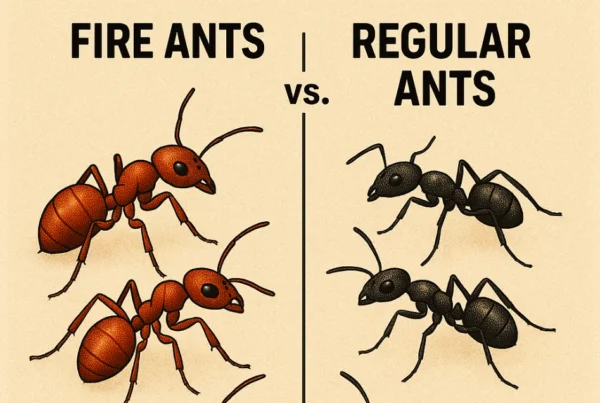

If you’ve spotted ants around your home, it’s crucial to know what kind you’re dealing with. While many household ants are just a nuisance, fire ants pose real danger with painful stings and aggressive behavior. Knowing the difference can help you act fast and effectively.
This guide explains the key differences between fire ants and regular ants, common risks, and the best control options, especially when professional help is needed.

What Are Fire Ants?
Fire ants are aggressive, reddish-brown ants known for painful stings and large mounds. Common in the southern U.S., they thrive in sunny, open spaces.
Characteristics:
- Reddish-brown with a darker abdomen.
- 1/8″ to 1/4″ in length.
- Build dome-shaped mounds (no central hole).
- Sting in groups when disturbed.
What Are Regular Ants?
“Regular ants” refer to typical household species like pavement ants, odorous house ants, and carpenter ants. They’re less aggressive but can cause other issues, like food contamination or structural damage.
Common Types of Regular Ants
- Odorous House Ants: Attracted to sweets, emit a foul smell when crushed.
- Pavement Ants: Nest under sidewalks and foundations.
- Carpenter Ants: Bore into wood, compromising structures.
- Pharaoh Ants: Spread rapidly indoors, especially in warm buildings.
Fire Ants vs. Regular Ants – Key Differences
| Feature | Fire Ants | Regular Ants |
| Color | Reddish-brown | Black, brown, or reddish tones |
| Behavior | Highly aggressive, sting repeatedly | Passive or non-aggressive |
| Nesting Location | Mounds in soil, sunny areas | Indoors, under pavement, in wood |
| Risk Level | High – painful, dangerous stings | Low to moderate – property or food risk |
| Identification Tip | Visible mound, no central entrance | Trail around food or walls indoors |
DIY vs. Professional Ant Control
DIY Control Methods
- Store-bought baits and traps.
- Vinegar, cinnamon, or diatomaceous earth barriers.
- Sealing cracks and storing food securely.
Limitations:
- Often ineffective for fire ants.
- Doesn’t reach hidden or deep nests.
- Misidentification reduces success.
Professional Ant Control
- Correct species ID (essential for fire ants).
- Targeted treatments and nest removal.
- Long-term prevention plans.
If you notice recurring mounds or bites, fire ants may be the culprit. A licensed pest control provider ensures safe, targeted elimination and prevention.
Explore: Ant Control Services
Other Ant Comparisons Worth Knowing
| Comparison | Key Differences |
| Fire Ants vs Carpenter Ants | Fire ants sting; carpenter ants damage wooden structures |
| Fire Ants vs Pharaoh Ants | Fire ants live outside; pharaoh ants infest interiors |
| Fire Ants vs Pavement Ants | Fire ants build visible mounds; pavement ants do not |
When to Call a Pest Control Expert
- Repeated sightings of ants or visible soil mounds.
- Stings, especially in children or pets.
- Failed DIY attempts.
- Damage to wooden structures.
Final Thoughts
Correct identification is key when dealing with ants. Fire ants require immediate attention due to their stinging behavior and health risks. While minor household ants can be controlled with DIY efforts, fire ant infestations are best left to the professionals.
FAQs
Can fire ants live indoors?
Primarily outdoors, but they can enter buildings through foundations or HVAC systems.
What makes fire ant stings dangerous?
They inject venom, causing painful welts, burning, and in some cases, allergic reactions.
Do carpenter ants sting like fire ants?
No. Carpenter ants bite and can damage wood, but they don’t sting or swarm like fire ants.
How fast can fire ants spread?
Very fast. They establish multiple colonies and quickly invade nearby areas if untreated.
Will one treatment eliminate fire ants?
Not usually. They require multiple, strategic treatments to fully eliminate.
Recent Posts / View All Posts